Friday, 31 May 2013

Santa Maria Sopra Minerva

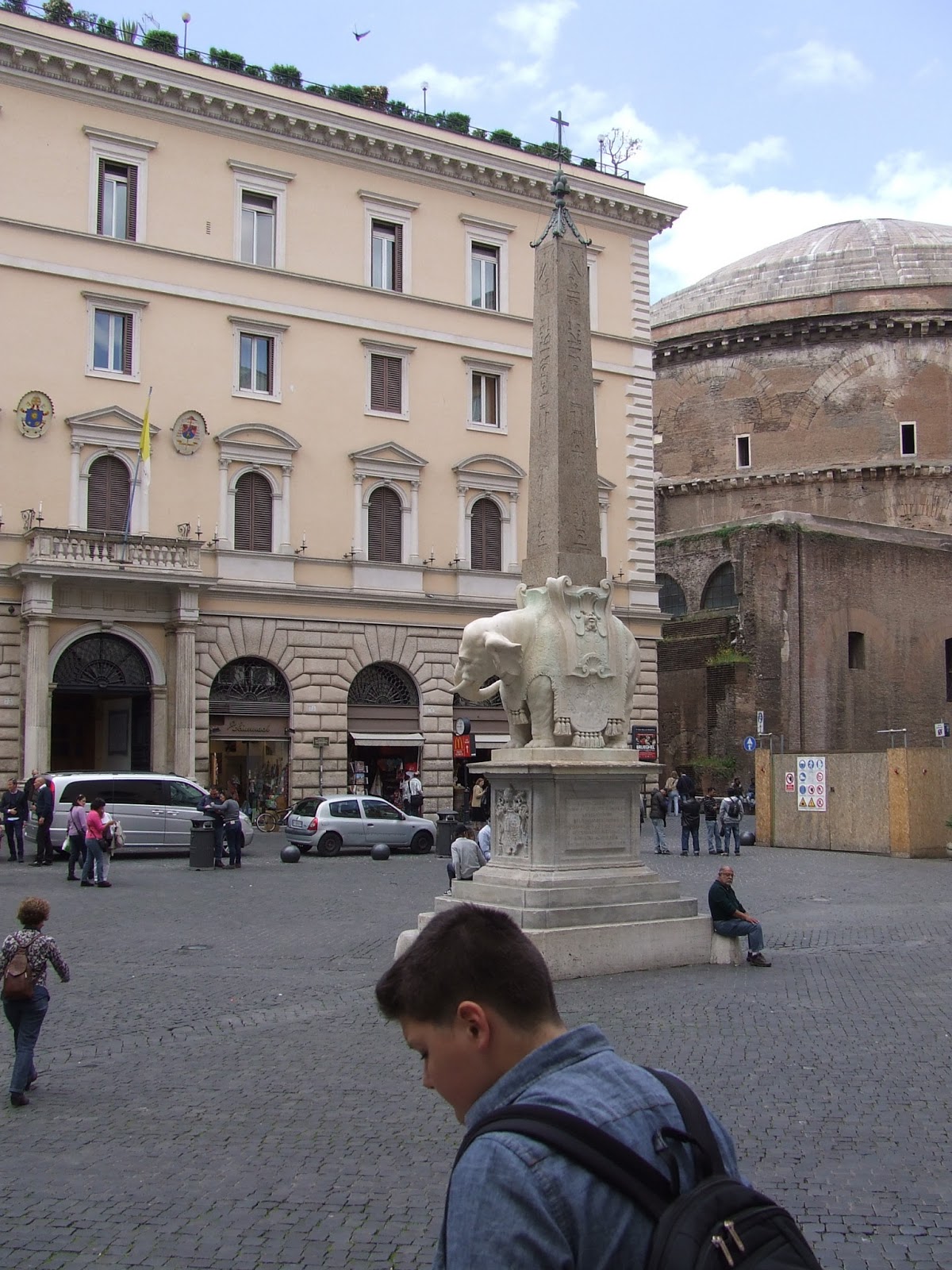
The church of Santa Maria Sopra Minerva is remarkable in several respects. It is said to be the only church with a gothic interior in Rome. It is the titular of H.E. Cormac Cardinal Murphy-O'Connor and outside may be seen an Egyptian obelisk carried upon the back of an Elephant! But there is more. Beneath the high altar lies the body of Saint Catherine of Siena, to the left of which may be seen a sculpture of the Risen Christ by Michelangelo and, then, the tomb of the Blessed ""Fra" Angelico. Perhaps I should pay more attention to guide books before my visits but, frankly, I found this quite jaw-dropping.


At the bottom we see another view of the elephant obelisk and, just creeping into view, the back end of the Pantheon.

Santa Croce in Gerusalemme

A short walk from St John Lateran is the Basilica of Santa Croce in Gerusalemme- so-called because when built by Saint Helena, the mother of Constantine, the floor was packed with earth brought from Jerusalem. Here are kept, in a side chapel, several important relics of the Passion including a large part of the titulus (the signboard placed on the cross on Pilate's orders), one of the nails, a couple of thorns, a small fragment of the true cross and a larger piece from the cross of the good thief. Photography being forbidden, I did not take any snaps in the chapel of the relics.

Wednesday, 29 May 2013

How not to visit the Vatican Museums

On the morning of Tuesday 23rd April we set out immediately after breakfast with the intention of visiting the Vatican Museums. At around  9am we found ourselves, to our dismay, at the end of a dense queue, several deep, and stretching over a hundred yards or so around the corner into the Viale Vaticano before the turn leading into the entrance. There seemed to be little chance of getting in in less than an hour. No sooner than had we arrived at this point than we were set upon by the representatives of various organisations offering to arrange tickets enabling us to avoid the queues and get straight in- at a price. Their persistence made our attempts to discuss the options open to us somewhat vexed. I am not the happiest of persons when I am being pressed to make a quick decision- my wife and I were being tackled simultaneously by a young man and a young woman- so I blurted out, "We'll come back tomorrow morning." "But tomorrow will be the papal audience and so it will be even busier", retorted the young woman. "Nevertheless," I declared, "we go!"- as we made a forceful exit from the queue. I was unsure as to whether we should come to regret that decision since the morrow would be our last day in Rome but I was quite sure I did not want to stand in a long queue being pestered and that even if we were to turn up the following day and find the same problem and so end up resorting to paying a grossly inflated rate for our tickets it would be on account of it being the only option left to us. 

We took the Metro then to San Giovanni and headed for the basilica of Santa Croce in Gerusalemme.

Monday, 27 May 2013

St Peter's Basilica - Again

Following our visit to the Scavi we made our exit through the Vatican Grottoes emerging under the arch at the northern end of the facade of the basilica. We were then able to re-enter the basilica through the narthex. The nave was somewhat crowded but we were able to make our way to past the high altar to where mass was about to begin at the Altar of the Cathedra. Mass was largely sung and in Latin so that we were able to actively participate. Some of the music was provided by what appeared to be a visiting choir of boys and men who, sadly, did not appear to know the chants of the mass. At the Communion they sang the Cesar Franck "Panis Angelicus" - which I confess is not one of my favourite pieces. After mass I had hoped to venerate St Peter's statue but was left in little doubt by one of the stewards ( I don't know the proper title of these gentlemen) that this would not be tolerated.
In fact there seems to be a deliberate policy of keeping people away from the statue as the barricades in the photo above will confirm. Here, as I have remarked elsewhere, things seem somewhat changed from my last visit in 2000. On the other hand it is good to know that Confession is still called the Sacrament of Penance here.
Before leaving St Peter's we were able to see the monument to the Stuarts- the tomb of James III and  Henry Benedict the Cardinal Duke of York.


Thursday, 23 May 2013

To the bones of St Peter

Exactly one month ago, on Monday 22nd April, we were privileged to visit the "Scavi"- the archaeologically excavated area under St Peter's Basilica- having booked our place on an English language guided tour well in advance back in January via the Vatican website. Our guide was a young Roman lady- an art historian- and we were the only Britons in the group.

The present basilica, as is well-known, was begun by Pope Julius II in 1506- the original basilica, built under Constantine, having become dangerously unstable. Immediately below the floor of the present basilica lie the Vatican Grottoes- the rather exotic name given to what would normally in other churches be termed the crypt- which extends under a large part of the building. It is here that many of the popes lie buried. Work carried out in 1939 for the construction of the tomb of Pope Pius XI revealed part of the Roman burial ground  or Necropolis which had been sealed and buried with the levelling of the site for the building of the basilica in the fourth century. Pope Pius XII authorised excavations which continued throughout the 1940s which revealed several mausolea and, ultimately, both the original grave of St Peter with the original monument over it, dating from the second century, and the loculus into which the bones of St Peter were later- presumably when the basilica was erected- replaced.

Entry to the Scavi is through a gateway to the south of the colonnade past security and Swiss Guards. Here, in a courtyard on the south side of the basilica, one stands on the site of the ancient Circus of Nero where St Peter was crucified. A tablet set in the paving marks the original site of the obelisk which was placed on the central spine of the circus and which now stands in St Peter's Square. Entering through a couple of rooms in which artefacts found in the excavations are displayed one soon descends through sealing doors to the ancient street level where the feeling of having been taken back through time is palpable and where almost the first sight that greets one is, in fact, a street!

The "houses" that line this street are in fact mausolea or tombs- despite looking from the outside very like houses of brick or stone in which the living might dwell. Inside they are decorated - mainly with fresco work but are also some mosaic work and as well as terracotta mouldings and the tombs served to house both burials (inhumation) and urns of ashes from cremation. The remarkable preservation is due to the siting of the basilica and the decision to raise the level of this part of the site in order to provide the foundations.

The Necropolis was on the southern slope of the Vatican hill along the northern boundary of the Circus of Nero. Following his martyrdom the body of St Peter was buried in a simple earthen grave on what was, at this stage, an undeveloped site. During the Second century the necropolis developed as wealthier citizens built tombs in the vicinity. Already at this time a priest named Gaius referred to a "trophy" or monument marking the grave. 
(continuation)
During the second and third centuries more mausolea were built and the Circus fell into disuse. An interesting feature of many of these edifices may be seen in the inscriptions announcing the will of the owner carrying information about who- generally other members of the family- the tombs are for. In some of these texts reference is made to the location "on the Vatican hill next to the Circus". During this period both cremation and inhumation were practised with an increasing tendency toward the latter as time went on. The occupants of the excavated part of the Necropolis appear to have been mostly pagan but one later mausoleum displays Christian imagery- an adapted image of Apollo as the Sun but with cruciform nimbus- is seen in a ceiling mosaic. Oddly enough, although I had long been familiar with this image through photographs, I was quite unprepared for its beauty and the sight of it was one of those rare occasions where I found my breath quite taken away by a sheer vision of loveliness. Unfortunately, from my point of view, one is not allowed to take photographs in the Scavi. By the time one sees the mausoleum with this mosaic the Apostle's tomb is quite close at hand.

Constantine's decision to close the Necropolis and erect the basilica was of profound significance implying both immense political will and extraordinary material resources. From the outset the intention was clearly to raise the altar of the basilica over Saint Peter's grave. Given the  grave's location with the surrounding necropolis and the fact of the Vatican Hill's falling away to the south it was deemed necessary to level the entire area. The roofs of the mausolea were removed and the site packed with earth and rubble. The walls of the mausolea were left in situ and additional walls strategically inserted as retaining structures for the massive infilling. The result for posterity of this infilling of this city of the dead may, I think, be compared to that of the ash of Vesuvius upon the city of the living Pompeiians with everything preserved snapshot-like at the moment of destruction. An additional benefit here is that excavation did not begin until modern archaeological techniques were available in the twentieth century. 

The experience of walking along the street of the Necropolis is barely like anything else I have experienced. From the light of mid-afternoon we had descended into a sort of night-time world- an ancient Roman street with modern, if subdued, lighting. One might make visual comparisons with a stage- or film-set because one looks up above the lighting and the rough top edges of the buildings to a "floating" hard reinforced concrete ceiling which is the base of the current floor of the Vatican Grottos. 

The tour lasts about an hour and a half and initially I found myself champing at the bit somewhat. I was eager to get to the relics of Saint Peter and we seemed to be spending rather a lot of time on the preliminaries. Guides do like to talk! Nevertheless it was absorbing and when we arrived in the area next to St Peter's tomb the site had been well and truly contextualised.

When Pope Pius XII  authorised the excavation the area around St Peter's tomb  had been initially excluded. A subsequent campaign involved the area around and underneath the tomb. It is possible to see a column from the original "trophy" referred to by Gaius and, through a small hole broken through into the loculus into which the bones were raised at the time of Constantine, some of the bones. These, following the excavation, were replaced in what I take to be perspex containers. Above this I think it is possible to see part of the base of the altar erected at the time of Pope St Gregory the Great- but I was unable to make out that particular structure. I do, however have a vivid recollection of seeing a clear part of the polished white marble facing of the altar erected over this by Pope Callixtus II in the twelfth century.

I should have liked longer to make out these several layers of masonry from the grave at bottom, to  the trophy of Gaius, the Constantinian loculus, the base of the altar of Gregory the Great and the altar of Callixtus II but it was nevertheless clear how this one small area had been repeatedly overbuilt with increasing grandeur for above those mentioned came the present altar, Bernini's baldacchino and Michelangelo's dome.

 All this honours the little spot of earth where the Fisherman's bones were laid after his ignominious death in the adjacent circus. And our guide pointed out an interesting fact. Most Christian churches are oriented, that is with the altar towards the eastern end but in St Peter's the altar is towards the west. This, she told us, is because the alignment of St Peter's burial followed Jewish custom and the basilica  follows the alignment of his burial. And the same is also true of other papal basilicas.

All too soon our visit was coming to an end.

We left the Scavi through the Vatican Grottos pausing at the Confession where the outer "casing" of the tomb is marked by an icon of Christ and the niche of the pallia. Here it is that, close to the Apostle's bones, the pallia rest before the pope gives them to metropolitan archbishops as a symbol of their union with the apostolic see.

It is an enormous privilege to be able to visit that holy spot and to catch a glimpse of St Peter's bones as I did on that afternoon. Given the way the world has changed even since my last visit to Rome in 2000 I can only marvel and wonder how much longer the opportunity will be available with such ease to ordinary pilgrims like myself. Thirteen years ago I was able to simply saunter into St Peter's Basilica unhindered to a mass and a Papal appearance. Now one has to queue and pass through security metal detectors and baggage X-rays simply to enter the Square.

Friday, 17 May 2013

San Pietro in Montorio and other sights


From Santa Maria in Trastevere we climbed to the church of San Pietro in Montorio- a church I had heard about since it had been the titular of Giulio Cardinal de Medici who had commissioned Raphael's last great painting, "The Transfiguration". Originally intended for his Cathedral of Narbonne in southern France- the then cardinal had been simultaneously Archbishop of Florence, Archbishop of Narbonne and Bishop of Worcester- the painting had been unfinished at Raphael's death in 1520 and was installed instead in his titular church here where it remained until stolen by Napoleon. Returned to Rome following the Congress of Vienna  which dealt with matters arising from the Napoleonic Wars Raphael's painting found its final home in the Vatican Pinacoteca. Cardinal Giulio de Medici was elected Pope in 1523 as Clement VII in which role he was happily able to confirm that the marriage of Henry VIII and Queen Catherine was perfectly valid. Less happily, he had to retreat to the Castel Sant'Angelo(bottom picture) when Rome was sacked by the Imperial troops in 1527.
A curious feature of this church was the way we found the pews draped in heavy off-white blankets.These seemed somewhat heavy for dust sheets- which they reminded me of- nor did protection for repair work seem consistent with the unprotected sanctuary and altars.

Thursday, 16 May 2013

Wednesday, 15 May 2013

Santa Maria in Trastevere 1


Santa Maria in Trastevere is undoubtedly one of the most beautiful churches in Rome! Externally it is distinguished by the mosaic decoration of the facade (below the pediment) while internally the mosaics of the apse, while rich and glowing in their colouring, are striking for their bold naturalism. Attributed to Pietro Cavallini (1259-c1330) a slightly older contemporary of Giotto, they are particularly noteworthy for the strong sense of relief created by the clear representation of directional lighting usually associated with that master.
Unfortunately my photos do not do justice to their subjects. Try as I might, I could not get a picture of the main image of the apse without reflected glare from the lighting. Cavallini's style is best seen in the three narrative panels of The Annunciation, The Nativity (with the annunciation to the shepherds) and The Presentation in the Temple.
 In a side chapel I managed to snap this curious fresco representing the Council of Trent- again apologies for the poor quality of the shot. In the foreground are several allegorical figures including a lady who, crowned with the papal tiara, represents Holy Church trampling error underfoot!
Briefly a papal residence, Santa Maria in Trastevere, was the titular of Henry Benedict Stuart the grandson of James II and brother of Charles Edward Stuart the young pretender ("Bonnie Prince Charlie"). Possibly the most illustrious member of the house of Stuart, he rose to become Dean of the Sacred College of Cardinals and participated in several conclaves.

Monday, 13 May 2013

Santa Cecilia in Trastevere


In view of the momentous visit planned for the afternoon of Monday 22nd April we decided to take the morning gently visiting some of the churches of Trastevere which lies on the same side of the Tiber but to the south of the Vatican. First was Santa Cecilia. Tradition has it that the basilica was built on the site of the house of the saint's family and it was here that her relics were brought from their original resting place in the Catacombs of Saint Callixtus. Under the altar is seen the famous sculpture by Stefano Maderno which depicts the body of Saint Cecilia as found when her tomb was opened in the sixteenth century. Somewhat appropriately, in the church of the patron saint of music, we arrived to find a lady playing the organ!
There are some notable mosaics in the apse and, I believe too that there are some impressive frescoes by Pietro Cavallini associated with the church but- unable to find them during our visit- I thought I had been mistaken in expecting them.

One famous holder of the title of Santa Cecilia was none other than Thomas Cardinal Wolsey Archbishop of York and Lord Chancellor of England.